Economics of Adventuring:
Currency:
- Generally, most market transactions occur in silver marks.
- Poorer villages and peasants typically transact in copper pieces, with the value 1/10th of a silve piece.
- Larger amounts would be transacted in gold pieces, with an amount 10 times that of a silver mark.
- Even larger quantities can be transacted in gold and silver bars. One bar of either silver or gold would equal 100 of either mark.
Currency Quick Reference Table
| Name | Abv. | Value in Silver oz. | Value in Gold oz. | Enc. per Unit | Units per 1 Enc. |
|---|---|---|---|---|---|
| Gold Ingot | gbar | 1000 Silver oz. | 100 Gold oz. | 0.5 | 2 Gold bars |
| Silver Ingot | sbar | 100 Silver oz. | 10 Gold oz. | 0.5 | 2 Silver bars |
| Gold Piece | gp | 10 Silver oz. | 1 Gold oz. | 0.005 | 200 Gold Pieces |
| Silver Piece | sp | 1 Silver oz. | 1/10th Gold oz. | 0.005 | 200 Silver Pieces |
| Copper Piece | cp | 1/10th Silver | 1/100th Gold | 0.005 | 200 Copper Pieces |
Exchange rates:
- Using a value of currency inappropriate to the situation will lead to a 1d8+8% overpayment.
- For example, attempting to pay a 10 pence meal with a gold piece could lead to a 12% overpayment.
- Sometimes, people won’t accept larger amounts at all. A small tavern having enough coinage on hand to provide the change on a gold ingot is very unlikely.
- Currency exchange to a higher or lower value can be done at financial institutions in large cities, with them taking a 1d4+4% cut off the top.
- Different regions will have different currency.
- Frequently visited coinage exchanges will have a 1d8%+4% cut. These usually exist in large cities. Even if they don’t recognize the currency, they have ways to evaluate the purity of the coinage to provide you with an approximately fair amount.
- If you skip this step entirely, your currency will have a 1d12+8% cost increase to mimic the distrust locals have of your foreign coinage.
Buying and Selling Equipment:
- Prices in the Rules Guide are already priced at a higher value to reflect the premium travelers and adventurers pay.
- With the correct connections, time spent haggling, and enough knowledge of market prices, an adventurer might be able to lower the costs by half.
- Most equipment can be bought in larger cities and market towns.
- More expensive or rare equipment can be acquired via connections, or a large amount of time spent waiting for the equipment’s creation.
- In villages and rural areas, much of the listed gear will be unavailable. This is up to the GM’s discretion and understanding of the area.
- Most services can be found in larger towns and cities with the amount of people offering labor. Rural villages may have lads or lasses of courage, looking to make more silver in one adventure than they’d likely see in a lifetime of work.
Hirelings and Day Labor:
- Hirelings that accompany the party during adventurers will request at least one half-share of loot, in addition to a daily pay.
- They will take no risks that their employers do not share.
- Combat statistics will be equivalent to a common human soldier.
- After a particularly dangerous adventure, the hireling will need to pass a morale check or move on from the party.
- Mage hirelings will usually be unwilling to join the party. They will often ask for a larger share and will never have spellcasting abilities beyond that of a first or second level mage.
- Many small communities may not have anyone available to hire.
- Larger villages may have a few ready to pursue a life of adventure.
- Cities and market towns have an almost unlimited amount of labor, but if they notice that employees don’t return, they won’t be likely to join up.
- Regular day laborers for construction, hauling equipment, and conducting business on the party’s behalf will only require a regular day wage.
- Food and lodgings must be provided by the party as well.
- When skill checks are needed, hirelings will have a +1 to a relevant skill check.
| Hireling Type | Cost/day |
|---|---|
| Bard of Small Repute | 2 sp |
| Common Prostitute | 2 sp |
| Dragoman or Skilled Interpreter | 10 sp |
| Elite Courtesan | 100 sp |
| Farmer | 1 sp |
| Guard, ordinary | 2 sp |
| Guard, sergeant, for every ten guards | 10 sp |
| Lawyer or Pleader | 10 sp |
| Mage of Minor Abilities | 200 sp |
| Mundane Physician | 10 sp |
| Porter willing to travel into the wilds | 5 sp |
| Porter on well traveled paths | 1 sp |
| Navigators | 5 sp |
| Sage, per question answered? | 200 sp |
| Sailor | 1 sp |
| Scribe or Clerk | 3 sp |
| Skilled Artisan | 5 sp |
| Unskilled Laborer | 1 sp |
| Veteran Sellsword | 10 sp |
| Wilderness Guide | 10 sp |
Services and Living Expenses:
- Heroes with a home can live comfortably off of their own resources. Other, less established, PCs will have to pay for their keep.
- Impoverished lifestyle: Covers the bare minimum of food and shelter. Adventurers suffer a -1 penalty to social skill checks, and must succeed in a physical saving throw to lower system strain after a night of sleep.
- Common lifestyle: Cover adequate food and shabby inn rooms. No penalties or benefits are granted.
- Rich lifestyle: Include a rented town house, small cleaning and cooking crew. While not being quite on the level of high nobility, allows penetration into higher social spheres of rich merchants and petty nobles.
- Noble lifestyle: The very best in fine housing and luxurious food. Servants and staff abound, alongside useful sycophants and parasites orbit looking to latch on to greater wealth.
- Once per game session, a player can ask a hanger-on or a member of their retinue to preform one task (if not overly humiliating, dangerous, or illegal).
| Services | |
|---|---|
| Impoverished lifestyle, per week | 5 sp |
| Common lifestyle, per week | 20 sp |
| Rich lifestyle, per week | 200 sp |
| Noble lifestyle, per week | 1,000 sp |
| Magical healing of wounds* | 10 sp/hp |
| Magical curing of disease* | 500 sp |
| Lifting a curse or undoing magic* | 1,000 sp |
| Casting a minor spell* | 250 sp |
| Bribe to overlook a minor crime | 10 sp |
| Bribe to overlook a major crime | 500 sp |
| Bribe to overlook a capital crime | 10,000 sp |
| Hire someone for a minor crime | 50 sp |
| Hire someone for a major crime | 1,000 sp |
| Hire someone for an infamous crime | 25,000 sp |
| ”*” These services are rarely available without personal connections or doing special favors, and many communities may lack them entirely. |
| Beasts and Transport | Cost |
|---|---|
| Horse, riding | 200 sp |
| Horse, draft | 150 sp |
| Horse, battle trained | 2,000 sp |
| Mule | 30 sp |
| Cow | 10 sp |
| Ox, plow-trained | 15 sp |
| Chicken | 1 sp |
| Pig | 3 sp |
| Dog, working | 20 sp |
| Sheep or goat | 5* sp |
| River ferry, per passenger | 10* cp |
| Ship passage, per expected day | 5* sp |
| Carriage travel, per mile | 10* cp |
| Cart travel, per mile | 5* cp |
| Rowboat | 30 sp |
| Small fishing boat | 200 sp |
| Merchant ship | 5,000 sp |
| War galleon | 50,000 sp |
Gear and Equipment:
Encumbrance:
- The encumbrance value attempts to emulate the volume and weight of items and gear. This provides a limit to the amount that an adventurer can carry.
- Generally measured in items.
- Most ordinary objects count as one item.
- Two-handed weapons, heavy objects, or unwieldy things may count as two or more.
- Very small objects do not count as items unless carried in large and unusual numbers. The encumbrance of gems, jewels, and other small but valuable items aren’t tracked, except for coins.
- Bulk goods (torches, empty waterskins, and oil flasks) can be bundled together to count as one encumbrance.
- During combat or time sensitive scenarios, taking apart a bundle requires a main action.
- Readied items are any item an adventurer can access easily and quickly.
- Can carry an amount of encumbrance equal to half their Strength attribute rounded down.
- Includes worn armor, carried shields, sheathed weapons, and anything else a PC wants immediate access to.
- Readied items can be used as a part of whatever action a PC would like to take, with no other action needed.
- Stowed items are items an adventurer carries with them that cannot be accessed quickly.
- Can carry an amount of encumbrance of stowed items equal to the adventurer’s Strength score.
- Includes items tucked away in packs, organized in pouches, and otherwise compartmentalized.
- Requires a main action to access these items.
- Characters can push their limits by carrying more than is comfortable.
- An extra two Readied or four Stowed items can be carried, but their Move action is changed 20 feet instead of 30.
- A further two Readied or four Stowed items can be carried beyond that, but that slows them down to 15 feet per Move action.
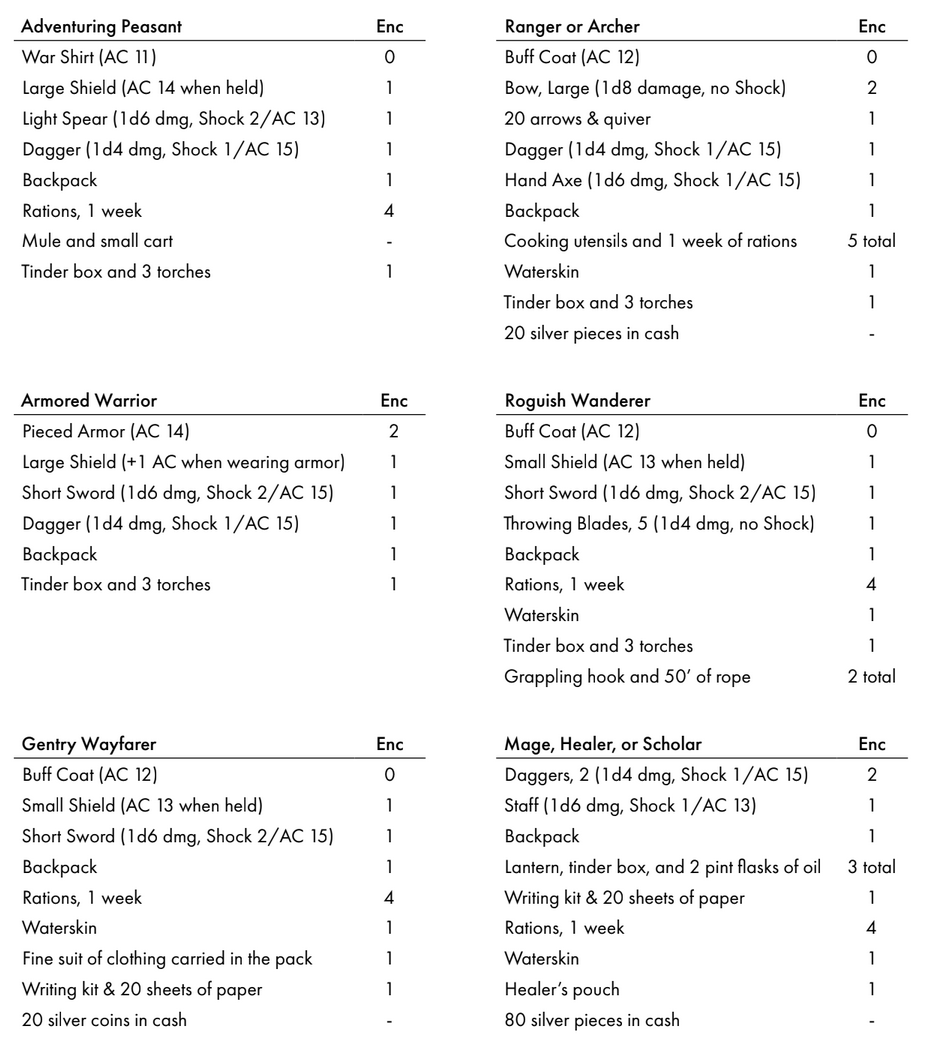
Gear and Gear Bundle Cost Table
| Items(s) | Cost | Enc. |
|---|---|---|
| Arrows, 20 | 2 sp | 1 |
| Backpack | 2 sp | 1^ |
| Boots | 2 sp | 1^ |
| Candle | 1 cp | - |
| Cart, one-horse | 50 sp | N/A |
| Clothes, common | 25 sp | 1^ |
| Clothes, fine | 100 sp | 1^ |
| Clothes, noble | 500 sp | 2^ |
| Cooking utensils | 4 sp | 1 |
| Crowbar | 4 sp | 1 |
| Firewood, for one night | 2 cp | 4 |
| Flask, metal, one pint | 3 sp | 1 |
| Grappling hook | 5 sp | 1 |
| Hammer or other small tool | 2 sp | 1 |
| Healer’s pouch | 5 sp | 1 |
| Iron spikes, 10 | 1 sp | 1 |
| Lantern | 10 sp | 1 |
| Mirror, hand | 10 sp | - |
| Oil, one pint | 1 sp | 1# |
| Paper, 10 sheets | 1 sp | - |
| Rations, one week | 5 sp | 4 |
| Rope, 50’ | 2 sp | 2 |
| Sack | 1 sp | 1 |
| Shovel, pick or similar tool | 4 sp | 2 |
| Tinder box | 1 sm | - |
| Torch | 2 cp | 1# |
| Waterskin, one gallon | 1 sp | 1 |
| Writing kit | 3 sp | 1 |
| Artisan’s Equipment | 50 sp | 5 |
| Criminal Tools | 100 sp | 3 |
| Dungeoneering Kit | 200 sp | 6 |
| Noble Courtier Outfit | 1,000 sp | 2 |
| Performer’s Implements | 100 sp | 3 |
| Wilderness Travel Gear | 100 sp | 5 |
| ”#” - Can be bundled in units of 3, for the same encumbrance. | ||
| ”^” - Does not count for encumbrance when worn. | ||
 |
Modifying/Customization Existing Equipment:
General Information:
- NPC Crafters, Experts, and Partial Experts create modifications for equipment using materials and substances gathered from their adventuring.
- Modified Equipment must be maintained by expert crafters as well. Given enough time without a maintainer the equipment will fail.
- Experts or Partial Experts with Craft-1 OR any PC with Artisan can modify equipment.
- The components needed for equipment modification come from magical monster parts, legendary jewels, ancient salvage, rare metals, or other occult materials.
- To make modifications, the character must have the requisite tools for their craft.
- ex. Forge for metalworking, sewing for cloth and leather armor, etc.
- It takes one week per level of Craft skill to install a new modification.
- With an assistant of at least Craft-0, halves the time.
- If doing only working, with breaks for sleeping and eating, the time is halved again.
- With an assistant of at least Craft-0, halves the time.
Maintaining Modifications:
- The character must have at least Craft-0 to maintain modifications.
- A character has a maintenance score equal the the total of their Intelligence and Constitution modifiers plus 3 times their Craft skill.
- Thus, an Expert PC with an Intelligence modifier of +1, a Constitution modifier of +0, and the Craft-0 skill would have a Maintenance score of 1.
- Modifications need to be maintained every 24-hours, or it will fail.
- Lack of maintenance for years or ages may result in complete item destruction.
- A crafter can maintain a number of modifications equal to their Maintenance score without impeding on normal adventuring.
- Does not require additional special equipment or materials.
- The crafter can double their maintenance if they do not adventure and spend their entire time working.
- A crafter who builds a masterwork item from scratch can tune it to better support modifications.
- First mod added to this item will cost twice in materials and supplementary costs, but requires no maintenance.
Example Modification:
Arrow Storm (Craft-2):
A bow or other projectile weapon automatically generates its own ammunition, albeit the conjured projectiles vanish a round after firing. This mod does not increase reload speed. Cost: One unit of salvage and 5,000 silver pieces.
Assassin’s Trinket (Craft-2):
A one-handed weapon is modified to adopt the shape of some item of jewelry or adornment. It can be shifted to or from this shape by the owner as an On Turn action. Cost: One unit of salvage and 1,000 silver pieces.
Augmented Gear (Craft-1):
A tool, medical kit, or other item of equipment is improved for a specific purpose chosen at the time of augmentation. Skill checks made for that purpose gain a +1 skill bonus with the item. Cost: One unit of salvage and 5,000 silver pieces.
Automatic Reload (Craft-2):
A hurlant can be modified to reload itself, if ammunition is available. Once per scene, a man-portable hurlant can be reloaded as an On Turn action. Cost: Two units of salvage and 10,000 silver pieces.
Customized (Craft-1):
The weapon or suit of armor has been carefully tailored for a specific user. When used by them, they gain a +1 to hit with the weapon or +1 Armor Class with the armor. This mod doesn’t work with shields. Cost: 1,000 silver pieces.
Flying Razor (Craft-1):
A throwing weapon is imbued with various esoteric materials, allowing it to return to the hand of its thrower after each attack. Cost: One unit of salvage and 5,000 silver pieces.
Harmonized Aegis (Craft-3):
A suit of armor is altered to harmonize with the dangerous sorceries of allied casters. Provided the wearer and the caster have had ten minutes to coordinate the protection, the wearer is unharmed by the caster’s harmful spells for the rest of the day, even if caught in their area of effect. Cost: One unit of salvage and 10,000 silver pieces.
Long Arm (Craft-2):
A ranged or thrown weapon is modified to double its normal and maximum rang- es. Cost: One unit of salvage and 5,000 silver pieces.
Manifold Mail (Craft-2):
A suit of armor is augmented to allow it to shift its appearance to any of five or six pre-set choices, mimicking normal clothing or other armor types as an On Turn action. The armor’s Encumbrance is not altered. Cost: One unit of salvage, 5,000 silver pieces.
Omened Aim (Craft-2):
Occult components improve a ranged or thrown weapon’s targeting, adding +1 to hit rolls. Cost: 4,000 silver pieces.
Preserving Grace (Craft-1):
A suit of clothing or armor is specially altered to preserve the wearer. Once per week, when the wearer is Mortally Wounded, they will automatically stabilize. Cost: One unit of salvage and 5,000 silver pieces.
Razor Edge (Craft-2):
A weapon has been given an im- proved edge or shifting weight system, adding +2 to the damage and Shock it does, albeit requiring far more care. Cost: One unit and 5,000 silver pieces.
Tailored Harness (Craft-2):
A suit of armor is altered to perfectly fit a single wearer, decreasing its effective Encumbrance by 1 for them only. This does not affect skill check penalties or Armored Magic Focus. Cost: 5,000 silver pieces.
Thirsting Blade (Craft-3):
A weapon is imbued with a fated inclination to harm, adding +1 to hit rolls. Cost: Two units of salvage and 10,000 silver pieces.
Building/Crafting New Equipment:
- Assuming a PC has the tools and workspace to fabricate a piece of equipment, they can generally do so.
- Raw materials for the equipment will cost half the usual retail price, and then some time must be spent crafting the gear.
- No skill check is needed to simply craft the objects if they are of a kind appropriate to the crafter’s background or habitual work.
- For unusual items, a skill check at difficulty 7 for simple objects, 9 for demanding works, and 11 for things only a specialist ought to be able to make might be required at the GM’s discretion.
- Small, simple equipment such as knives, spears, bundles of torches, cloaks, sacks, or the like takes about an hour to make for each piece or bundle of six simple objects such as torches.
- Items that requires significant craftsmanship to make an adequate item, such as most clothing, leather armor, blunt weaponry, movable furniture, saddles, or other objects that require skill but not particularly lengthy effort can be made with one day of work per item.
- Objects that are particularly large or that require very careful construction to make, such as large tempered blades, ox-carts, hourglasses, metal armor, or the like require one week of work to complete.
- Crafters in a hurry can make an Int/Craft or Dex/Craft check against difficulty 9 to halve the time involved. If the crafter has an assistant with at least Craft-0 to help them, the skill check is made at difficulty 7. On a failure, half the raw materials were ruined and no speed gained.
Masterwork Items:
- A PC with the Artisan Focus or a background as a weaponsmith, armorer, or other maker of a specific type of goods can attempt to make a masterwork piece of equipment.
- The raw materials for such an undertaking cost ten times as much as the retail price of an ordinary item and the time needed to build it is twice as long.
- At the end of that period, the crafter makes an Int/ Craft or Dex/Craft skill check against difficulty 10.
- On a success, the piece is a masterwork.
- On a failure, the item is no better than an ordinary item.
- Masterwork weaponry grants a +1 bonus to hit rolls with the item.
- Masterwork armor counts as 1 fewer point of Encumbrance, down to a minimum of 1 point, albeit not for purposes of the Armored Magic Focus.
- Masterwork items of other kinds may grant similar minor benefits at the GM’s discretion.
Jury-Rigging Equipment:
- Jury-rig’ing together a piece of equipment on short notice is possible.
- If the materials they have to work with don’t seem completely inadequate to the GM, the crafter can make an Int/Craft or Dex/Craft skill check.
- DC of 7 for something that seems crude but plausible, to a DC of 10, for a jury-rig that stretches the boundaries of plausibility.
- The time taken is five minutes for small, simple objects.
- Fifteen minutes for ones that would normally require some craftsmanship
- One hour for large objects or those that would normally need careful construction.
- If the time is taken and the skill check is a success, the crafter has a usable item that will last at least as long as is needed for the particular purpose they jury-rigged it for.
- It will never work for longer than a day before falling to irreparable pieces.
Building Structures:
PCs who want to oversee the construction of buildings and other large structures can ask the GM about the relevant rules and tables.
- If a PC is capable of personally overseeing the undertaking, these prices can be decreased by 10% due to saved labor and the avoidance of wastage.
- The time to build these structures will depend on how much help is available.
- Assuming all the needed resources are on-site, one skilled worker can build 25 silver pieces worth of the structure for each day of labor.
- Thus, a building worth 10,000 silver could be constructed in 40 days by a team of ten skilled laborers.
- Unskilled laborers or those with no experience in construction are worth only 5 silver pieces of completed work per day.
- Large or complex structures built with less than 10% skilled labor may be less than perfect in execution.
Working as a Crafter:
PCs with salable professional skills can try to make some money by plying their trade, but this is a difficult undertaking.
- Few local crafters will have any interest in dealing with a potentially unreliable adventurer, and local guild laws and customs may flatly forbid strangers from working in a trade.
- Often a PC will have to make do with piecework and under-the-table help given to employers who are in no rush to pay them.
- A PC with Craft or Work or some other salable skill can generally make one silver piece per day per skill level, to a minimum of 1 silver piece.
- The longer such work goes on, however, the more pressure they’re likely to feel to join whatever guilds or social circles control the business in the area.