Introduction
In this world, your character seeks adventure. Whether fighting against the constant peril of monstruous creatures, defending communities from the depredations of their neighbors, delving in to the ancient deeps that [Ancients] once occupied, or exploring the trackless wilderness of a [calamity-struck world], there is treasure, glory, and terrible death to be found by the brave. - Kevin Crawford, Worlds Without Number (pg. 4)
Keep the following in mind while creating your character:
- What is your character’s past? Your character’s origin may be mundane, but what knack, quality, or capability separates them from other folk?
- What are your characters goals and ambitions? What is your characters purpose?
- Your character MUST be able to work with the rest of the group. There are plenty of loner characters in media, but you are not alone at the table. The goal is to cooperate and participate with the rest of the group.
Follow These Steps
You can find form fillable character sheets here: (Default, D&D Style)
-
Your character has 6 separate statistics to indicate the overarching Attributes of your character. You can read more details about attribute scores here.
- Roll 3d6 (three, six-sided die), then add them together. Write down this number and repeat six times for each Attribute.
- If you know which scores you want to assign to each Attribute, do so. If not, simply fill them out using the following order: Str, Dex, Con, Int, Wis, Cha.
- If you used random rolls you may change one of your random scores to 14.
- If your rolls are particularly terrible, you may use the following array instead: 14, 12, 11, 10, 9, and 7, but you cannot change any of your stats to 14.
-
Write down your attribute modifier in the space next to your attribute. There is a modifier table on the Attributes page to reference.
-
Roll a 1d20 for your character’s Background. Or, if you know where you want to take your character, choose from the list. Note down any information that you think would be important to your character’s past.
- Write down the Background’s Free Skill at Level-0 (ex. Craft-0, Sail-0, etc.)
-
Decide if you’d like to take the Quick Skills, select skills from the Learning table, or embrace randomness and roll for Skills.
- Option 1: Take the listed Quick Skills.
- Option 2: Choose two Skills from the Learning Table (excluding the “Any Skill” options)
- Option 3: Roll 3 times, from any combination of the d6 Growth Table or the d8 Learning Table.
- As a starting character, the maximum skill level is Level-1. If for any reason your skill level would go over Level-1, you are able to take one level in any other skill instead.
-
Choose your class. Look through the following pages to see how you want your character to play.
-
The Expert - Thieves, Diplomats, Scholars, etc.
-
The Warrior - Knights, Soldiers, Marksmen, etc.
-
The Mage - Magic users (see Traditions below)
-
The Adventurer - Combination classes. Click on the link to see examples.
-
If any of the casters look interesting, the Spellcasting/Partial Mage Traditions are in the list below.
-
If you’re not able to acheive the class fantasy you want from these options, talk to me and we’ll probably be able to make something that you find interesting.
-
-
Choose your Foci. These are knacks and abilities unique to your character. The class that you’ve chosen to play will have a class table with the amount of Foci you are able to pick at level 1. Some classes can choose any Foci, and others can only choose those related to combat.
-
Pick one Free Skill to increase by one level. Keep in mind, the Level-1 cap on skills for new characters still applies here. This skill could represent outside interests, natural talents, hobby expertise, or other personal focuses.
-
For Full and Partial Mages, finalize your Magical Tradition picks and select your starting Arts and Spells. You can also calculate your Effort pools now too.
- Your starting Spell counts, learned Arts, and Effort pools can be seen on the relevant tradition page.
-
Roll your hit points using your class table, then add your constitution modifier. No matter what, the minimum amount of HP a character has is 1. If your character hits 0 HP, your character is either Mortally Wounded or killed.
-
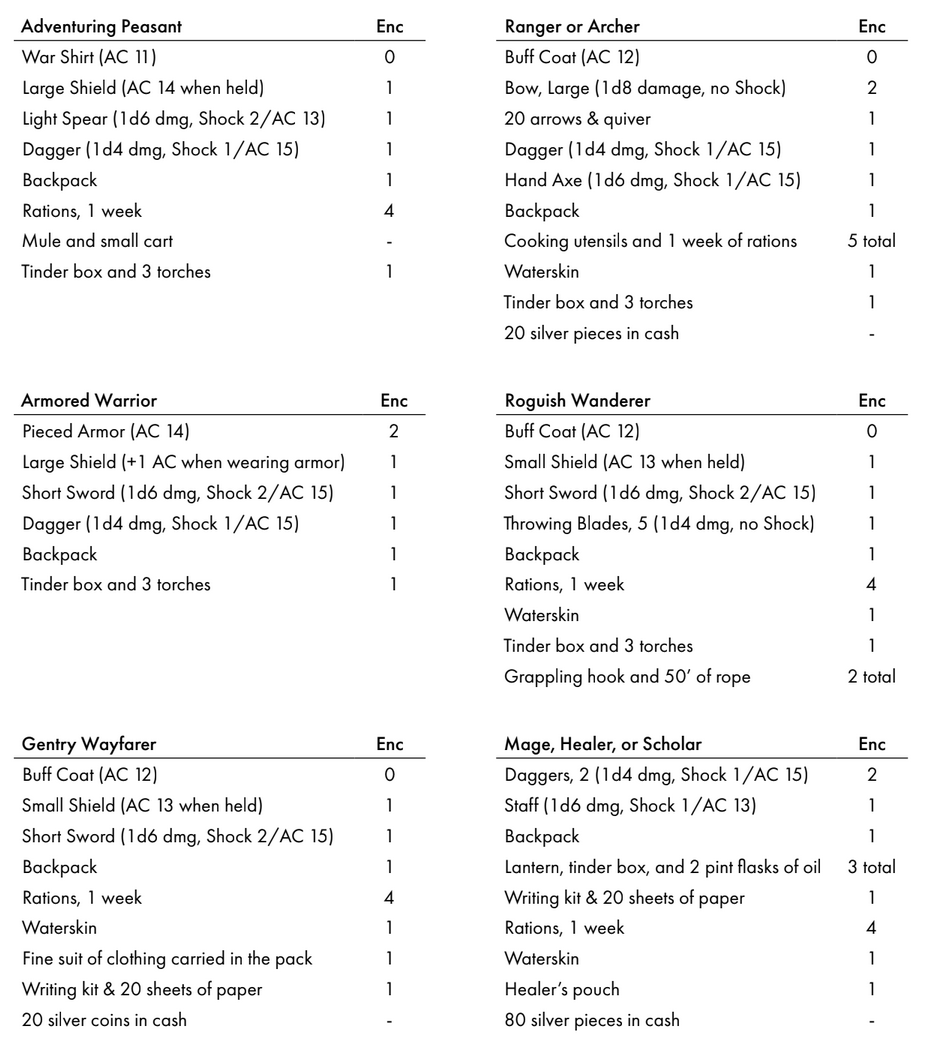
Select an equipment package from below. Or, roll 3d6 x 10 to find your starting silver and buy your starting equipment using that money using the items and armor tables.
-
Record your base attack bonus (again, listed in your class table). Then record the total hit bonus for each weapon you have available to you.
- (Attribute Modifier of Weapon) + (Base Attack Bonus) + (Punch/Stab/Shoot level, based on weapon type).
- If you have no levels in Punch/Stab/Shoot, take a -2 penalty to hit.
- Check out the weapon table on the Weapons and Armor page to see details.
-
Record the damage die of your weapon with the associated attribute modifier in the damage section of your Weapons table.
-
Record your Armor Class (how difficult it is to land an attack on you) on your character sheet.
- This is equal to your base AC from armor + your Dexterity modifier.
- If you have no armor, your base AC is 10. Still add your Dex modifier.
- Check the armor tables on the Weapons and Armor page to see AC for different armor.
-
Record your Saving Throws.
- Physical Saving Throw:
- Equal to 16 - (Your Level) - (Best of Str or Con Modifier).
- Evasion Saving Throw:
- Equal to 16 - (Your Level) - (Best of Dex or Int Modifier).
- Mental Saving Throw:
- Equal to 16 - (Your Level) - (Best of Wis or Cha Modifier).
- Luck Saving Throw:
- Equal to 16 - (Your Level).
- Physical Saving Throw:
-
Now that you have the mechanics behind your character figured out, let’s find out what your character is actually like! This is not a checklist. If you feel like it doesn’t apply to your character, then skip it! It’s just a list of ideas to ponder that’ll likely come in handy during roleplay.
-
What is your character’s past? Your character’s origin may be mundane, but what knack, quality, or capability separates them from other folk?
-
Goals and drives!
- At least one should tie you into the beginning of the campaign. Why is your character adventuring? What is your character looking for?
- More can be involved, but think about a long-term goal that’ll help push your character in a certain direction.
- Think, wanting to become rich. Or gaining acceptance from your family. Or finding unknown knowledge. Or achieving fame.
- It’ll help understand where and why your character takes actions. Where you want to go next, or what to do when there’s nothing immediately pressing.
-
Major weakness!
- What will make your character seriously hesitate? What is the innermost fear of your character? What will shake them to the core?
- Could be early trauma regarding parental figures. Could be a massive debilitating fear of spiders. Could be a younger sibling under threat.
- It makes roleplay more interesting. If you keep your weaknesses in the back of your head, it helps you make suboptimal choices for roleplay. Choosing to make suboptimal decisions is hard, but it’s a key part of any good character.
- It makes your character more authentic. After all, no one is completely fearless and unflappable.
-
Values!
- What you character believes in.
- Does your character fundamentally believe in the goodness of the human spirit? Or do they believe that everyone is selfish to their core?
- Does your character believe in absolute justice and law? Or does your character believe that justice is manipulated by those with power?
- Does your character believe the weak deserve to be punished? Or does your character believe that the weak deserve to be saved?
- It doesn’t have to be any of the above, but ask yourself what your character believes in most strongly. It’ll help drive you when you need to make difficult choices, or how to interact with other people/NPCs.
-
Bonds!
- Who/what your character is tied to.
- Could be any noun. If you have siblings or parents, those are obvious bonds. Could be a academic institution. Could be a former lover. Could be your childhood home, village, or church. Perhaps it’s an event? Really anything, that ties your character to something else.
- This is mostly for me, the GM. If I can incorporate your backstory and bonds, it gives me some juicy hooks for you later down the line, but it also gives you stuff to work with as well.
- Flesh the bonds out a bit. Don’t only write that you have a sister. Note how old she is, where she was last you saw here, and what your relationship is like.
-